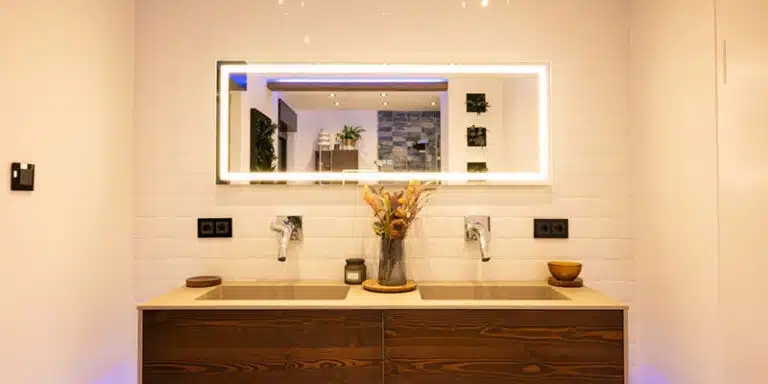
Mirrors are commonly used in the hospitality industry, but with the wide variety of mirror types available, it can be challenging to identify which one is suitable for your project.
Understanding how to choose the right type is essential. I have been in the LED mirror market for over 10 years, and today I will introduce you to the latest technology in mirrors, helping you select the right option when sourcing suppliers.
Aluminum Mirror
An aluminum mirror is a type of mirror that uses aluminum as its reflective layer. It is often cost-effective and offers approximately 85-90% reflectivity, making it the standard choice for mirror coatings.
Its manufacturing process is simple; the float glass will be cleaned with pure water. And then the glass is polished and dried before entering the coating room. In this room, a technique called magnetron sputtering deposition is used to apply a layer of aluminum coating to the glass surface through an oxidation reaction.
To protect this aluminum coating, a corrosion-resistant lacquer and a waterproof lacquer are applied.
Aluminum mirrors can be made using various types of flat glass substrates to meet the demands of different markets. For example, ultra-clear float glass is suitable for high-end markets, while tinted glass can create colorful mirrors for decorative purposes. Tempered glass is also available to cater to more price-sensitive customers.
Silver Mirror

A silver mirror uses silver as its reflective layer, increasing its reflectivity to 95-99%. It is more expensive than aluminum mirrors and is mostly used in high-end hotel bathrooms.
they are produced using the chemical silver plating method on a fully automated production line.
First, the glass sheets are cleaned and polished with pure water to ensure they are free from impurities. Next, the surface is sensitized using a stannous chloride solution and activated with palladium chloride and silver nitrate solutions. The glass is then coated with freshly prepared silver-ammonia and reducing solutions applied to the glass substrate. After a brief oxidation-reduction reaction lasting 2 to 3 minutes, a reflective silver coating forms on the surface of the glass.
To protect the silver layer, a copper sulfate solution combined with a reducing agent is uniformly sprayed onto the glass, resulting in a dense and even copper layer. After washing the copper layer with ionized water, a primer containing lead is evenly applied to the copper surface using a paint spraying machine. Finally, a protective topcoat is sprayed over the primer.
Also read: Why Do Mirrors Get Black Spots?
Aluminum vs. Silver Mirrors
| Property | Aluminum | Silver |
| Reflectivity (visible) | ~85–90% | ~95–99% |
| UV reflectivity | Excellent | Poor |
| Cost | Lower | Higher |
| Oxidation resistance | Moderate (needs coating) | Oxidizes quickly |
| Common use | Telescopes, optics | High-end mirrors, photography |
Copper & Lead Free Mirror
Copper and lead-free mirrors, often referred to as eco-friendly silver mirrors, do not contain harmful copper or lead layers. Lead is known to be detrimental to the environment.
These mirrors are produced using a process similar to that of conventional silver mirrors. The manufacturing process begins by creating a silver reflective layer on the glass surface. This is followed by the application of a spray-on organic silicone curing agent, which passivates the silver layer and protects its physical and chemical stability. A painting machine is then used to apply an acid-resistant primer and a high-hardness waterproof topcoat, both of which are lead-free.
The production of copper and lead-free silver mirrors effectively addresses the environmental pollution associated with traditional silver mirror processes, which often use copper sulfate displacement reactions. As a result, this method is truly green and eco-friendly.
Also read: What is a Copper Free Mirror?
Epoxy Mirror

An epoxy mirror is a newly developed, eco-friendly mirror. It is made by applying a special epoxy paint as a backing onto either an aluminum mirror or a copper-free silver mirror. This epoxy paint is known for its strong adhesion and excellent resistance to acids, alkalis, corrosion, water, and heat.
Not only does the epoxy mirror meet environmental standards, but it also fulfills demands for quality and durability. Additionally, its lower manufacturing costs significantly reduce decoration budgets, making it a cost-effective option for home or office decor.
Antique Mirror

An antique mirror embodies a charming vintage aesthetic. Its retro, elegant, and luxurious appearance makes it a perfect addition to any interior design. They are especially cherished by enthusiasts of retro-style decor.
The production process involves applying various antique patterns onto the silver mirror using embossing rollers. After a specific chemical reaction and oxidation treatment, the glass surface develops a unique coating with distinct shapes and colors. Finally, the silver mirror is coated with protective paint layers.
Tinted Mirror

A tinted mirror, also known as a colored mirror, is a type of mirror that features a colored reflection. Traditional colored mirrors are limited by the color of the glass used; however, modern technology has advanced significantly. Innovations such as offline coating and vacuum magnetron sputtering technology enable the deposition of sputtered atoms onto clear float glass through a process called physical vapor deposition (PVD) coating.
By introducing different gases during this process, various film layers can be created, resulting in an almost limitless array of color options for mirrors.
Polycarbonate Mirror
Polycarbonate mirrors use polycarbonate plastic as their substrate instead of float glass. This type of plastic material is lightweight and does not easily break, making it easier to transport.
They are widely used in the hospitality sector, particularly in settings where safety, durability, and aesthetics all matter.
Hotels & Resorts
- Guest bathrooms & vanity areas — safe alternative to glass in shower enclosures and wet areas
- Gym & fitness centers — wall-to-wall mirrors for workout areas where glass poses a safety risk
- Pool & spa areas — moisture and humidity resistance makes them ideal
Restaurants & Bars
- Decorative wall panels — used for visual depth and ambiance
- Back-bar displays — behind shelving to reflect bottles and create visual appeal
- Feature walls — creative interior design elements
Safety-Critical Spaces
- Public restrooms — vandal-resistant and tamper-proof in high-traffic areas
- Elevators & lobbies — safety mirrors and decorative panels
- Children’s areas — play zones and kids’ clubs where glass is a hazard
Polycarbonate Mirror vs. Glass Mirror
| Feature | Polycarbonate Mirror | Glass Mirror |
| Weight | Light | Heavy |
| Safety | Shatter-proof | Can shatter |
| Clarity | Very good | Excellent |
| Cost | Moderate | Lower to moderate |
| Durability | Very high | Moderate |
| Customization | Easy to cut/shape | Limited |
Also read: Mirror Quality